
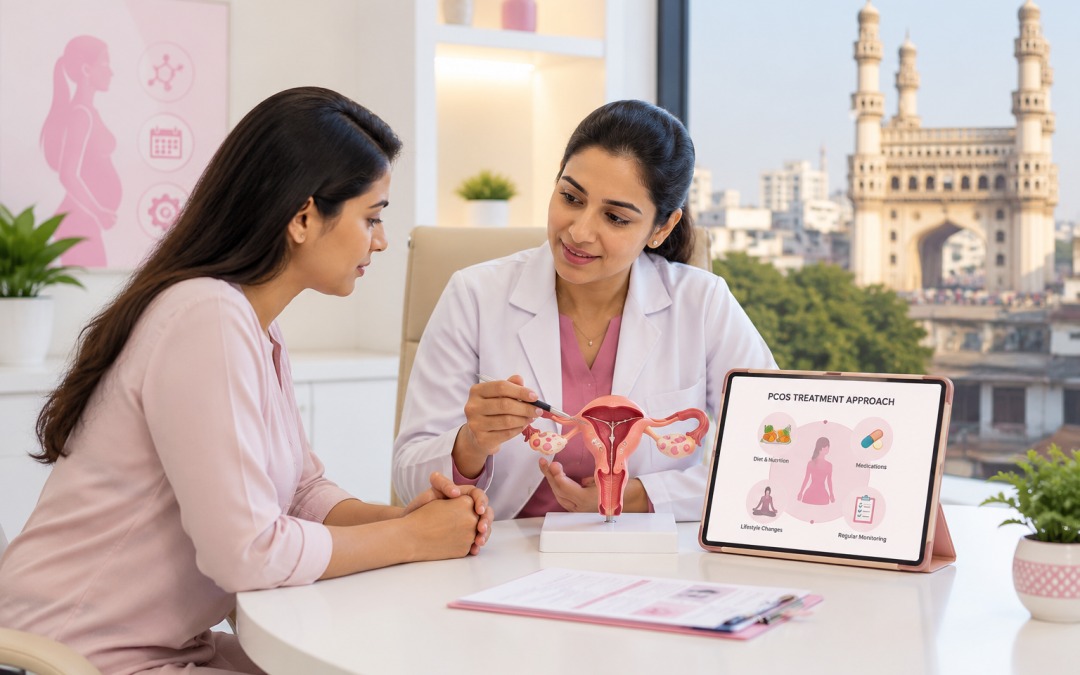
One of the most common questions women hear after a PCOS/PMOS diagnosis is: “So what happens now?” The honest answer is — it depends, and that’s actually good news. PCOS/PMOS treatment isn’t a single prescription; it’s a ladder, and most women don’t need to climb straight to the top of it. This guide walks through that ladder step by step, so you know exactly what each stage involves, how long it typically takes, and when it’s time to move to the next one.
Think of this as your map. If you want the full detail on any single step — the exact tests involved, or the specifics of an IVF cycle for PCOS/PMOS — those are covered in-depth elsewhere on our blog; here, we’re connecting the dots between all of them.
Step 1: Lifestyle Changes — Where Almost Everyone Starts
For a large number of women, especially those who are newly diagnosed, the first line of treatment isn’t medication at all — it’s lifestyle. This isn’t about willpower; it’s about biology. PCOS/PMOS is closely tied to insulin resistance, and even a modest 5–10% reduction in body weight can restore ovulation in many women.
What this stage typically includes:
- A low-glycemic, whole-food diet that keeps blood sugar stable
- Regular physical activity — a mix of cardio and strength training tends to work best for insulin sensitivity
- Stress management, since chronic stress raises cortisol, which further disrupts hormonal balance
- Sleep correction, particularly important if sleep apnoea is present
How long before you see results? Most doctors give lifestyle changes 3–6 months before reassessing, since hormonal shifts take time to translate into regular cycles.
Step 2: Ovulation Induction — The First Fertility-Focused Step
Once pregnancy becomes the goal, treatment shifts toward inducing regular ovulation directly:
- Letrozole — often used when Clomid doesn’t work as well, and increasingly preferred as a first-line option for PCOS/PMOS specifically
- Gonadotropins — injectable hormones used when oral medications aren’t enough, requiring closer monitoring
At this stage, many women conceive with medication alone, monitored through cycle tracking and ultrasound to confirm ovulation is actually happening.
Step 3: IUI (Intrauterine Insemination)
If ovulation induction alone doesn’t lead to pregnancy after several cycles, IUI is often added to the plan. Sperm is placed directly into the uterus around the time of ovulation, timed precisely using the same medications from Step 3. IUI is typically recommended for:
- Mild to moderate PCOS/PMOS with otherwise normal fallopian tubes
- Cases with no significant male-factor infertility
IUI is less invasive than IVF, which is why it’s usually tried first — but its success rate per cycle is modest, so most specialists recommend re-evaluating after 3–4 unsuccessful cycles rather than continuing indefinitely.
Step 4: IVF — When More Control Is Needed
IVF becomes the recommended path when:
- Ovulation induction and IUI haven’t resulted in pregnancy
- There are additional fertility factors involved (tubal issues, male-factor infertility, or advanced maternal age)
- A woman has severe anovulation that doesn’t respond well to simpler medication
Here’s what makes IVF different for PCOS/PMOS patients specifically: because PCOS/PMOS ovaries tend to respond strongly to stimulation, the protocol is deliberately adjusted to avoid Ovarian Hyperstimulation Syndrome (OHSS) — a risk that’s higher in PCOS/PMOS patients due to a naturally higher follicle count. This usually means:
- Lower starting doses of stimulation medication, closely monitored
- An antagonist protocol to prevent premature ovulation
- A frozen embryo transfer (FET) in many cases, rather than a fresh transfer, which further reduces OHSS risk and often improves implantation outcomes
The upside of this careful approach is that PCOS/PMOS patients, once safely stimulated, often have a strong number of good-quality eggs to work with — which is reflected in the success rates.
Where Lifestyle Still Matters, Even During Fertility Treatment
It’s worth noting that lifestyle changes from Step 1 don’t get discarded once you move to medication or IVF — they continue to support outcomes at every stage. Managing insulin resistance, in particular, has been shown to improve egg quality and response to stimulation, regardless of which treatment step you’re on.
How MotherToBe Guides This Journey
At MotherToBe Fertility Centre, Hyderabad, Dr. S. Vyjayanthi personally evaluates where each patient genuinely sits on this ladder — rather than defaulting to the most advanced (and expensive) option first. With training under Prof. Adam Balen, one of the world’s leading PCOS treatment Hyderabad, and over 20 years of clinical experience, the treatment plan is built around your specific hormone profile, cycle history, and how your body has responded to previous treatment, not a one-size-fits-all protocol.
For patients who do need IVF, MotherToBe’s PCOS/PMOS-specific protocols have delivered success rates of 60–65% per cycle for women under 35, and 45–50% for women aged 35–40 — supported by careful OHSS-prevention strategies and a strong embryology lab.
Frequently Asked Questions
Do I have to try every step in order, or can I skip ahead?
Not always in strict order — your specialist may recommend skipping straight to IUI or IVF if there are additional fertility factors, your age is a limiting factor, or previous treatments have already been tried elsewhere. The ladder is a general guide, not a mandatory sequence for every patient.
How long does the entire journey typically take, from diagnosis to pregnancy?
It varies enormously — some women conceive within a few months of lifestyle changes and medication, while others may need 12–18 months progressing through several steps. Age and how quickly your body responds are the biggest factors.
Is IVF always more successful than IUI for PCOS/PMOS patients?
Generally yes, IVF has higher success rates per cycle, but it’s also more invasive and costly. Most specialists still recommend trying simpler treatments first unless there’s a clear medical reason to move faster.
Conclusion
PCOS/PMOS treatment is rarely about choosing one option — it’s about knowing where you currently stand on the ladder, and moving up only as far as you actually need to. For many women, lifestyle changes and simple medication are enough. For others, the path leads to IUI or IVF, and that’s not a failure of the earlier steps — it’s simply the next right one.
Call to Action: Not sure which step is right for you? Book a personalised evaluation with Dr. S. Vyjayanthi at MotherToBe Fertility Centre’s PCOS/PMOS Clinic in Madhapur, Hyderabad. Call 7093617272 / 7093607272, or ask about our free Thursday consultation slots.