
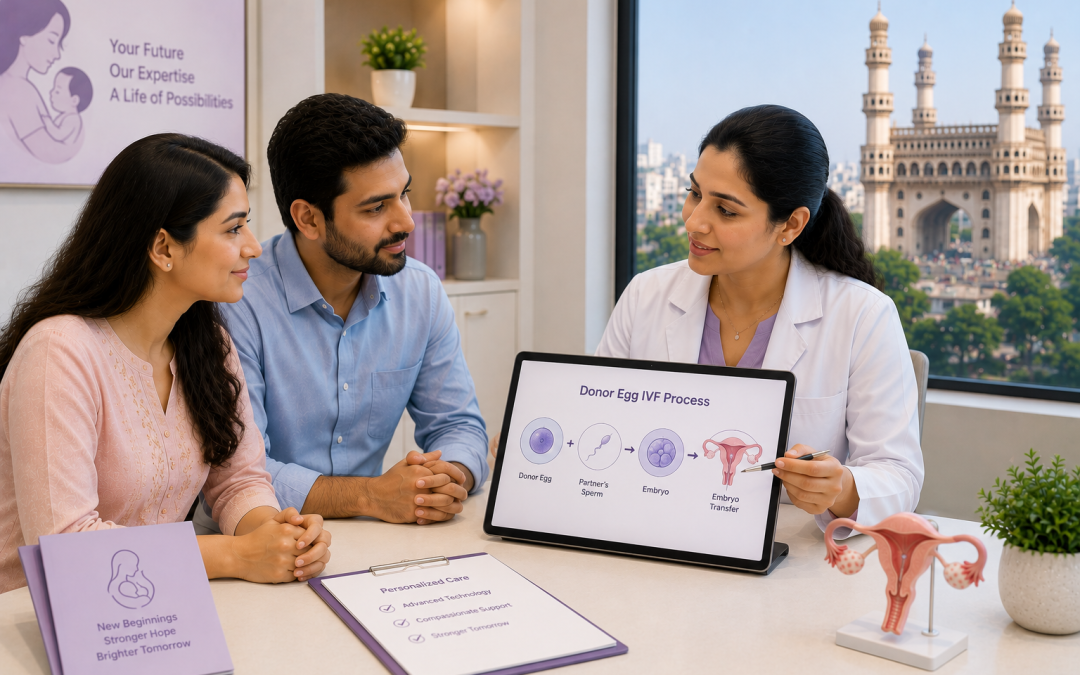
For some women, the barrier to pregnancy isn’t the uterus or the ability to carry a child — it’s egg quantity or quality. Donor egg IVF exists specifically for this situation, and it’s one of the most successful forms of assisted reproduction available, precisely because it removes egg-related factors from the equation entirely. Here’s who it’s actually recommended for, and what the process genuinely involves.
Who Typically Needs Donor Egg IVF
1. Diminished Ovarian Reserve or Age-Related Decline
As women age, both egg quantity and quality decline — and past a certain point, even with maximum stimulation, IVF using a woman’s own eggs may yield very few, or no, chromosomally normal embryos. Donor eggs, typically from younger donors, sidestep this limitation.
2. Premature Ovarian Insufficiency (POI)
Some women experience ovarian failure well before typical menopause age, sometimes in their 20s or 30s, due to genetic, autoimmune, or unknown causes. Without functioning ovaries producing viable eggs, donor eggs are often the most direct path to pregnancy.
3. Repeated IVF Failure Linked to Egg Quality
When multiple IVF cycles using a woman’s own eggs have resulted in poor embryo development or repeated implantation failure — and testing points toward egg quality as the likely factor — donor eggs are often recommended as the next step, rather than continuing with additional cycles unlikely to succeed.
4. Genetic Conditions
Women who carry a genetic condition they don’t wish to pass on, and for whom genetic testing of their own embryos isn’t a suitable or sufficient option, may choose donor eggs to reduce this specific risk.
5. Certain Medical Treatments
Women who’ve undergone chemotherapy or radiation without prior fertility preservation, and whose ovarian function has been significantly affected as a result, may turn to donor eggs if their own eggs are no longer viable.
How Donor Egg IVF Works in India
India’s donor programs operate under the Assisted Reproductive Technology (Regulation) Act, 2021, which sets clear rules most patients should know about:
- Egg donors must be between 23 and 35 years old
- Donation happens through registered ART banks, not informal or direct arrangements
- Egg Donors can donate only once in a lifetime.
- Donor identity remains anonymous to the recipient, and vice versa, as a legal requirement
- All donors undergo mandatory health, genetic, and infectious disease screening before donation is approved
This regulatory structure exists specifically to protect both donors and recipients, and any clinic offering donor egg IVF in India should be operating within a registered ART bank framework.
The Process, Step by Step
1. Consultation and Matching
Your specialist reviews your medical history and discusses donor characteristics relevant to matching (typically physical characteristics and blood type, coordinated through the registered ART bank).
2. Donor Screening (Already Completed by the Bank)
Registered donors have already undergone hormonal, genetic, and infectious disease screening as part of the bank’s registration process before being made available for matching.
3. Cycle Synchronisation or Frozen Donor Eggs
Depending on whether fresh or previously frozen (vitrified) donor eggs are used, your specialist will either synchronise your uterine lining preparation with the donor’s retrieval cycle, or work on a more flexible timeline using frozen donor eggs — the latter has become increasingly common and offers more scheduling flexibility.
4. Recipient Preparation
Your uterine lining is prepared using hormone medication (oestrogen, followed by progesterone), similar to preparation for a frozen embryo transfer, timed precisely to be ready when the donor eggs are fertilised.
5. Fertilisation
Donor eggs are fertilised with sperm (from a partner or donor) in the lab, typically using ICSI to maximise fertilisation success.
6. Embryo Transfer
The resulting embryo — fresh or frozen — is transferred into the recipient’s prepared uterus, following the same procedure as a standard embryo transfer.
7. Pregnancy Test and Follow-Up
A blood test roughly 10–14 days after transfer confirms pregnancy, with continued monitoring and progesterone support in early pregnancy.
What Success Rates Actually Look Like
Because donor eggs typically come from young, healthy, thoroughly screened donors, donor egg IVF generally shows meaningfully higher success rates per cycle than standard IVF using a recipient’s own eggs at advanced maternal age — since the primary age-related factor (egg quality) has effectively been removed from the equation. The recipient’s age still matters for uterine and overall pregnancy health, but far less than it would if her own eggs were being used.
Addressing the Emotional Side
Choosing donor egg IVF often comes with complex emotions — grief over not using one’s own genetic material is common and valid, alongside hope for the pregnancy ahead. Clinics offering donor egg IVF in Hyderabad typically provide counselling support as part of this process, and many patients find it genuinely helpful to process this decision with support rather than navigating it alone.
How MotherToBe Supports Donor Egg IVF Patients
At MotherToBe Fertility Centre, Hyderabad, Dr. S. Vyjayanthi guides patients through donor egg IVF within India’s regulated ART framework, working with registered donor banks and providing clear, honest counselling about when donor eggs are genuinely the most appropriate path — rather than defaulting to it prematurely when other options remain viable.
Frequently Asked Questions
Will my child be genetically related to me if I use donor eggs?
The child will be genetically related to the sperm provider (partner or donor) and will be carried and delivered by the recipient, but will not share the recipient’s genetic material if donor eggs are used — this is an important distinction many patients want to think through with counselling support.
How is a donor matched to me?
Matching is typically based on physical characteristics and blood type, coordinated through the registered ART bank, while maintaining anonymity between donor and recipient as required by law.
Is donor egg IVF more successful than standard IVF for older women?
Generally yes, specifically because donor eggs come from younger donors with better egg quality — this is exactly why donor eggs are often recommended once a woman’s own egg quality becomes the primary barrier to success.
Conclusion
Donor egg IVF exists for a specific, well-defined set of situations — primarily where egg quantity or quality, not the ability to carry a pregnancy, is the barrier. Operating within India’s regulated ART framework, it offers meaningfully higher success rates for the right candidates, alongside an emotional journey that deserves proper support and counselling throughout.
Call to Action: Wondering if donor egg IVF is the right path for you? Book a confidential consultation with Dr. S. Vyjayanthi at MotherToBe Fertility Centre, Madhapur, Hyderabad. Call 7093617272 / 7093607272, or ask about our free Thursday consultation slots.