
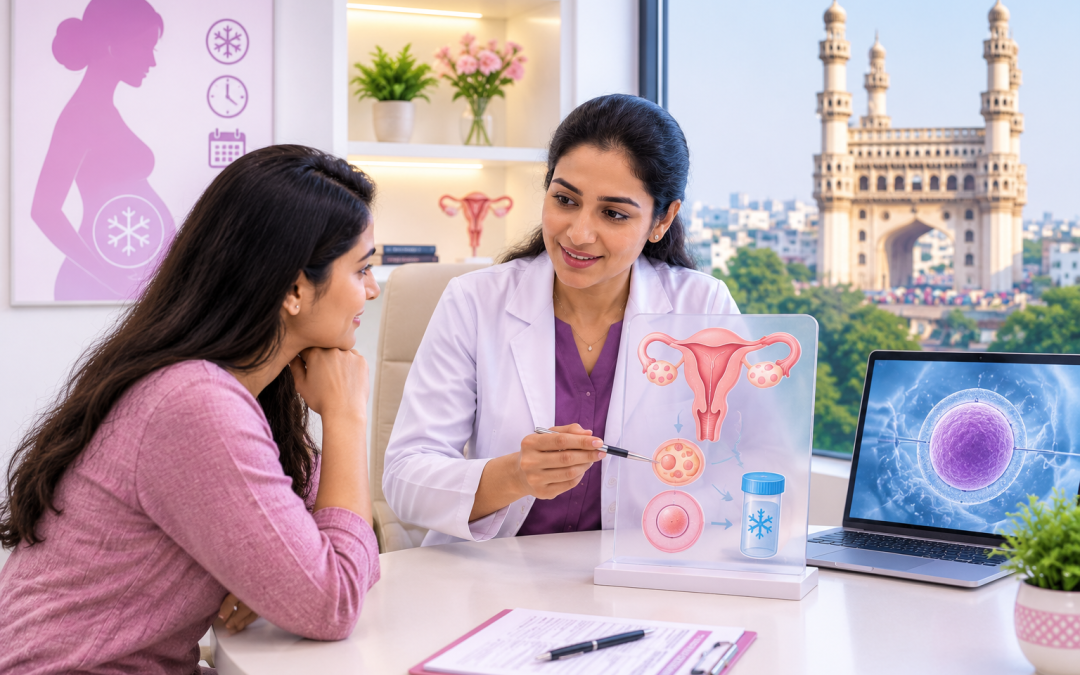
“Am I too young to think about this?” and “Have I already left it too late?” are the two most common thoughts women have when egg freezing comes up — often within the same conversation. The truth sits somewhere more useful than either extreme: egg freezing works at both ages, but what it actually offers you is meaningfully different depending on which decade you’re in. Here’s the real comparison, without the marketing gloss.
Why Age Is the Single Biggest Factor in Egg Freezing
Egg freezing preserves eggs at the age they’re retrieved — not at whatever age you eventually use them. This means the biological “clock” is effectively paused at the moment of freezing, which is exactly why the age you freeze at matters so much more than the age you plan to use them.
Two things decline with age: egg quantity (the total number of eggs available) and egg quality (the proportion of those eggs that are chromosomally normal). Both directly affect how many usable, healthy eggs you’ll have frozen — and therefore your realistic chances of a future pregnancy from them.
Freezing in Your 20s: What It Actually Offers
- Higher egg quality on average — a significantly higher proportion of eggs retrieved in your 20s are chromosomally normal compared to eggs retrieved later, which directly improves future success rates per egg used.
- Often a stronger response to stimulation — younger ovaries frequently produce a higher number of eggs per retrieval cycle, sometimes meaning fewer cycles are needed to bank a good number of eggs.
- More “runway” — eggs frozen in your 20s remain viable in storage for many years, giving you significant flexibility before you need to consider using them.
- The trade-off: it’s the least likely decade to feel “necessary” — you may not yet know if or when you’ll need these eggs, which makes the upfront decision and cost harder to justify for some women.
Freezing in Your 30s: What It Actually Offers
- Still a meaningfully useful window, especially in the early-to-mid 30s, before the more significant quality decline that tends to accelerate after 35.
- A clearer sense of “why” — many women in their 30s have a more concrete reason (career stage, relationship timing, medical treatment ahead), which often makes the decision feel more immediately justified.
- More eggs may be needed per cycle, or more retrieval cycles overall, to bank the same number of chromosomally normal eggs compared to freezing in your 20s.
- The trade-off: waiting further into your 30s (particularly past 35) means each cycle typically yields fewer usable eggs, and costs can rise correspondingly if multiple cycles are needed.
So, Which Decade Is “Right”?
There isn’t a universal right answer — but here’s a practical way to think about it:
- If you’re in your 20s and egg freezing is something you’re seriously considering (not just curious about), freezing now maximises egg quality for the future, even if you’re unsure exactly when you’ll use them.
- If you’re in your early 30s, this is still a strong window — quality has declined only modestly from your 20s, and by now many women have a clearer personal or medical reason driving the decision.
- If you’re in your mid-to-late 30s, egg freezing is still absolutely worth discussing with a specialist — it’s simply more likely that your doctor will recommend a slightly different approach, such as planning for more than one retrieval cycle, or discussing embryo freezing as an alternative if you have a partner.
What the Process Involves, Regardless of Age
The clinical process itself doesn’t change much by decade:
- Ovarian stimulation — 10–14 days of hormone injections to encourage multiple eggs to mature simultaneously
- Monitoring — regular ultrasounds and blood tests to track follicle growth and adjust medication
- Egg retrieval — a short, minimally invasive procedure under sedation
- Vitrification — a rapid-freezing technique that preserves the eggs without ice-crystal damage, used industry-wide as the current gold standard
What differs by age is mainly the number of eggs retrieved per cycle and the proportion likely to be chromosomally normal — which is why your specialist’s advice on “how many cycles” or “how many eggs to bank” will vary based on your age at the time.
A Note on Realistic Expectations
Egg freezing significantly improves your future options — it does not guarantee a future pregnancy. Success ultimately depends on the number of eggs frozen, their quality at the time of freezing, and factors at the time you eventually use them, including uterine health and overall fertility status. A good specialist will walk you through a realistic, personalised estimate rather than a generic promise, based on your age, ovarian reserve testing (AMH levels), and response during stimulation.
How MotherToBe Approaches Egg Freezing at Every Age
At MotherToBe Fertility Centre, Hyderabad, Dr. S. Vyjayanthi begins every egg freezing consultation in Hyderabad with ovarian reserve testing and a personalised discussion of what your specific age and test results mean for your likely outcomes — rather than a one-size-fits-all recommendation. Whether you’re 27 and exploring your options early, or 34 and making a more time-sensitive decision, the goal is the same: giving you an honest, individualised picture before you commit to a cycle.
Frequently Asked Questions
Is there an age after which egg freezing is no longer worth considering?
There’s no strict cut-off, but the value of freezing generally decreases as egg quality declines with age — most specialists still consider freezing worthwhile into the early-to-mid 40s in select cases, though outcomes are more variable and expectations need to be realistic.
How many eggs should I aim to freeze?
This depends heavily on your age and personal goals, and your specialist will typically recommend a target based on your ovarian reserve testing and how many future pregnancy attempts you want to plan for — there’s no single universal number.
Does freezing eggs in my 20s mean I definitely won’t need IVF later?
Not necessarily — frozen eggs still need to be thawed, fertilised, and transferred through an IVF-based process when you’re ready to use them. Egg freezing preserves the eggs; it doesn’t replace the treatment process needed to eventually achieve pregnancy from them.
Conclusion
Freezing in your 20s generally offers higher egg quality and more flexibility; freezing in your 30s often comes with a clearer personal reason and is still a strong option, particularly earlier in the decade. The right time isn’t a fixed number — it’s the point where your personal readiness meets your individual fertility profile, which is exactly what a proper consultation is designed to clarify.
Call to Action: Curious what your own egg freezing timeline could look like? Book a consultation with Dr. S. Vyjayanthi at MotherToBe Fertility Centre, Madhapur, Hyderabad, for personalised ovarian reserve testing and guidance. Call 7093617272 / 7093607272, or ask about our free Thursday consultation slots.