
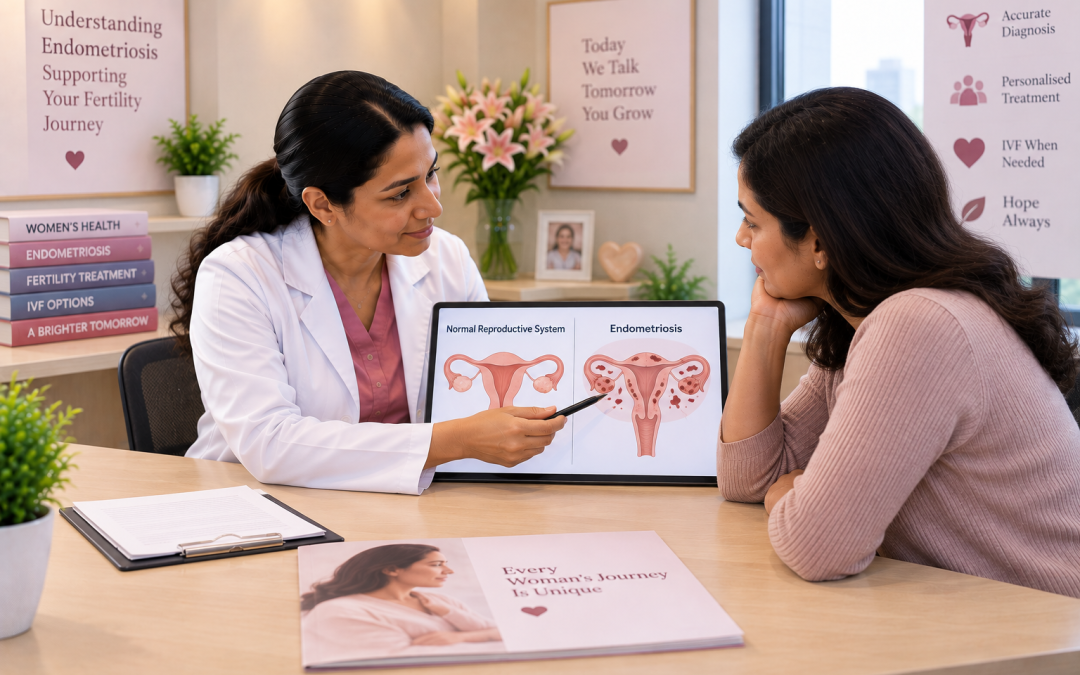
Endometriosis and infertility are closely linked, but the condition affects fertility in different ways from one person to another. Some women with endometriosis conceive without treatment, while others experience delayed conception, reduced ovarian reserve, tubal or pelvic-factor infertility, pain, or repeated treatment challenges. The treatment plan should therefore be based on age, symptoms, ovarian reserve, anatomy, previous surgery, duration of infertility and partner factors rather than on the diagnosis alone.
How endometriosis can affect fertility
Endometriosis can alter pelvic anatomy, cause inflammation, affect the ovaries and fallopian tubes, and sometimes reduce access to the egg or sperm. Endometriomas can also affect ovarian tissue, and previous ovarian surgery may influence reserve. Not every lesion has the same fertility significance, so the extent and location of disease matter. A fertility-focused evaluation looks at the whole reproductive pathway rather than assuming endometriosis explains every problem.
Symptoms do not always predict fertility impact
Severe pelvic pain does not necessarily mean severe infertility, and minimal pain does not exclude significant disease. Some patients are diagnosed during infertility evaluation despite having few symptoms. This is why treatment decisions should not be based on pain score alone. Menstrual history, ultrasound, previous operative findings, ovarian reserve and tubal assessment can all contribute to planning.
Surgery versus fertility treatment
Surgery may be appropriate for selected patients because of pain, suspicious masses, anatomy or other indications, but repeated ovarian surgery can also affect ovarian reserve. When pregnancy is the main goal, the decision to operate should consider age, reserve, previous surgery, endometrioma size and whether assisted reproduction is likely to be needed. Surgery is not automatically required before IVF in every patient with endometriosis.
When IVF may be considered
IVF can be considered when there are blocked tubes, moderate-to-severe disease, significant male-factor infertility, reduced time because of age, low ovarian reserve or unsuccessful simpler treatment. IVF does not remove endometriosis; it bypasses some fertility barriers by retrieving eggs and fertilising them in the laboratory. The stimulation and transfer plan should still account for the individual’s symptoms and medical history.
Endometriosis, ovarian reserve and egg retrieval
Patients with ovarian endometriomas often ask whether retrieval is safe and whether the cyst should be removed first. The answer depends on size, symptoms, access to follicles, prior surgery and suspicion of other pathology. Ovarian reserve markers are useful because they help estimate response, but they should not be interpreted as direct measures of egg quality or natural fertility.
Questions to ask before choosing a pathway
Ask whether the main fertility barrier appears to be ovulation, tubal anatomy, ovarian reserve, age, male factors or the endometriosis itself. Ask what surgery would achieve, what it might risk, whether IUI is reasonable, when IVF would be recommended and how previous surgery affects planning. A clear explanation helps avoid both unnecessary delay and unnecessary intervention.
How this topic fits into a complete fertility evaluation
Endometriosis And Infertility should not be considered in isolation. Fertility decisions usually combine several pieces of information, including endometriosis, pelvic pain, fertility, IVF, ovarian reserve. A finding that appears important on one report may become less important when the rest of the history is reviewed, while a subtle issue can become more relevant when it repeats across cycles. This is why the most useful consultation is structured around the couple’s complete reproductive timeline, not only the latest test result. If previous treatment has been attempted, bring stimulation records, semen reports, scan findings, embryology information and transfer details where available.
Questions worth asking at the consultation
Ask the clinician what the working diagnosis is, which findings are confirmed, what remains uncertain, and how endometriosis and infertility changes the recommended plan. Also ask what the alternatives are, what would make the team change course, which tests are essential, and which tests are optional. If a treatment or add-on is proposed, ask what outcome it is expected to improve and what evidence supports its use in your specific situation. Clear decision points are especially helpful in fertility treatment because they prevent repeated cycles from continuing without a defined reason.
Use online information as a preparation tool, not a diagnosis
Search results can help patients learn the language of endometriosis and infertility, but online information cannot account for age, medical history, ultrasound findings, semen factors, previous pregnancies or prior treatment response. Be cautious with content that promises guaranteed pregnancy, a fixed success rate, a permanent cure or one protocol for everyone. Reliable fertility education should explain uncertainty, describe alternatives and encourage questions. The purpose of reading before an appointment is to make the consultation more productive, not to replace an individual medical assessment.
A practical decision checklist before treatment
Before acting on information about endometriosis and infertility, write down the exact clinical question you are trying to answer. Confirm which reports are current, which findings have been repeated, and whether both partners have been assessed where relevant. Ask how the proposed next step addresses the limiting fertility factor, what the expected benefits and burdens are, and how long the plan will be tried before review. If several options are reasonable, compare them by time, invasiveness, cost, safety and how much useful information each option is likely to provide. This makes the treatment pathway easier to understand and reduces pressure to choose an intervention simply because it is more advanced.
Related questions people often search
endometriosis fertility. The phrase endometriosis fertility is useful as a search starting point, but the clinical meaning depends on the wider fertility history. A specialist should connect the term to the patient’s diagnosis, test results, age and treatment goals.
endometriosis pregnancy. The phrase endometriosis pregnancy is useful as a search starting point, but the clinical meaning depends on the wider fertility history. A specialist should connect the term to the patient’s diagnosis, test results, age and treatment goals.
endometriosis IVF. The phrase endometriosis IVF is useful as a search starting point, but the clinical meaning depends on the wider fertility history. A specialist should connect the term to the patient’s diagnosis, test results, age and treatment goals.
infertility due to endometriosis. The phrase infertility due to endometriosis is useful as a search starting point, but the clinical meaning depends on the wider fertility history. A specialist should connect the term to the patient’s diagnosis, test results, age and treatment goals.
Specialist fertility evaluation at MotherToBe
For an individual assessment, patients can review the profile of Dr. S. Vyjayanthi, Director & Consultant Fertility Specialist at MotherToBe Fertility Clinic & Academy, Madhapur, Hyderabad. Treatment decisions should be based on the complete clinical context, including diagnosis, reproductive age, previous treatment, partner factors and personal goals. female infertility treatment provides the relevant service-page overview for this topic.
Key takeaways
The central point is that endometriosis and infertility is a clinical context rather than a single number or label. The most appropriate next step depends on the diagnosis, reproductive age, partner factors, previous treatment and personal goals. A good fertility plan should be understandable: you should know why each test or treatment is being recommended, what could change the plan and when progress will be reviewed. This approach supports informed decision-making while avoiding both unnecessary delay and unnecessary intervention.
Frequently Asked Questions
Can endometriosis cause infertility?
It can contribute to infertility through inflammation, ovarian, tubal and pelvic factors, but not every person with endometriosis is infertile.
Does endometriosis always require IVF?
No. Treatment depends on age, disease extent, tubes, ovarian reserve, sperm factors and previous treatment.
Should an endometrioma always be removed before IVF?
No. The decision is individualised because surgery may have benefits in selected situations but can also affect ovarian tissue.
Can endometriosis return after surgery?
Recurrence is possible. Long-term management and fertility timing should be discussed with the treating clinician.
Next step
If this topic is relevant to your fertility journey, review female infertility treatment and prepare your previous reports, treatment records and questions for a personalised consultation. Medical decisions should be made after individual evaluation rather than from online information alone.