
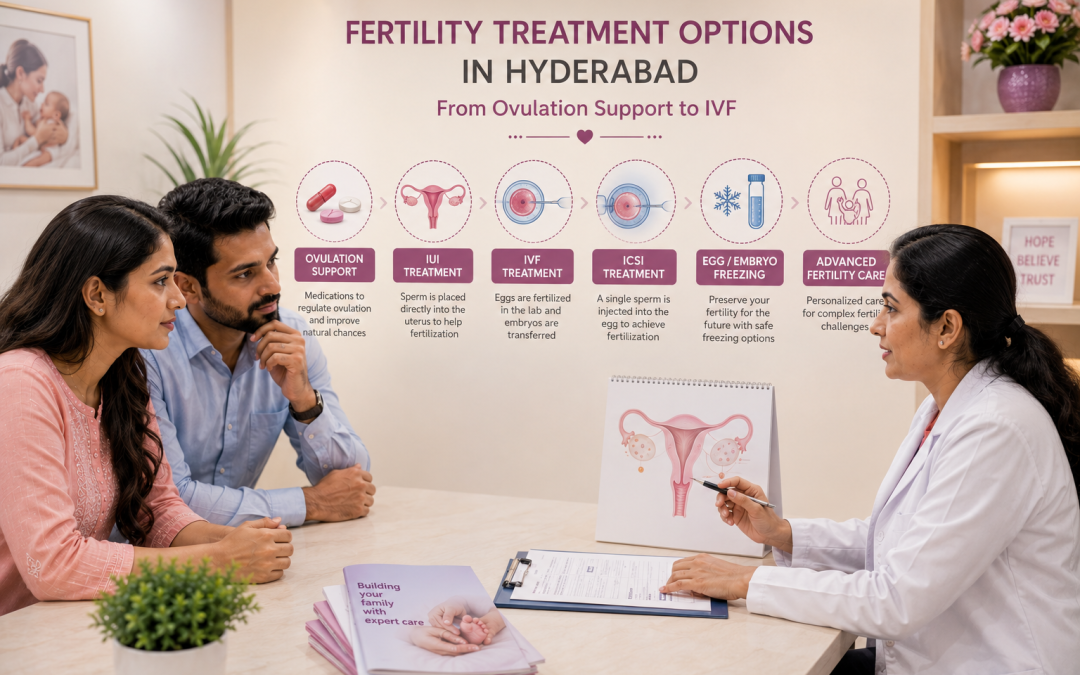
There is no single ‘best fertility treatment in Hyderabad’ for every patient. The right treatment depends on why pregnancy has not occurred, age, duration of infertility, previous treatment and personal priorities. A good plan uses the least complex effective option when appropriate, while recognising situations where moving to IVF or another advanced treatment may be more efficient.
Ovulation support
When irregular or absent ovulation is the main issue, medicines may be used to support or induce ovulation. Monitoring and timing depend on the medication and diagnosis. PCOS is a common example where ovulation-focused treatment may be considered.
Intrauterine insemination (IUI)
IUI places prepared sperm into the uterus around ovulation. It may be considered in selected cases, but its usefulness depends on age, semen parameters, tubal status and diagnosis.
IVF
IVF involves ovarian stimulation, egg retrieval, fertilisation and embryo culture, followed by transfer or freezing. It may be recommended for tubal problems, significant male-factor infertility, lower-probability situations for simpler treatment, or after previous treatment has not worked.
ICSI
ICSI is a laboratory method in which a single sperm is injected into an egg. It has clear uses in some male-factor and fertilisation situations, but ASRM’s 2026 committee opinion notes that the benefit of ICSI for non-male-factor indications should not simply be assumed.
Surgery and other procedures
In selected patients, hysteroscopy, laparoscopy or treatment of specific uterine or tubal problems may be considered. Surgery should be linked to a defined diagnosis and expected benefit.
Fertility preservation
Egg, embryo or sperm freezing may be relevant before gonadotoxic medical treatment or for some planned fertility-preservation goals. Ovarian tissue cryopreservation is another option in selected medical situations.
How the right option is chosen
The most useful question is not ‘which treatment is best?’ but ‘which treatment is most appropriate for this diagnosis at this time?’ Review fertility treatment options at MotherToBe and discuss the trade-offs with a specialist.
Match treatment intensity to the diagnosis
A simpler treatment is not always better, and a more advanced treatment is not always better. The goal is to choose an intervention whose expected benefit justifies its burden, cost and risk for the specific diagnosis. Age and time already spent trying can influence how quickly a plan escalates.
Ask for a stop-or-review point
Before starting a treatment such as ovulation induction or IUI, ask how many cycles are reasonable before reassessment. Before IVF, ask what information from the first cycle would change the next protocol. Defined review points prevent treatment from continuing indefinitely without a clear reason.
Specialist Fertility Treatment Planning at MotherToBe
At MotherToBe Fertility Clinic & Academy, Madhapur, Hyderabad, fertility care is led by Dr. S. Vyjayanthi, MD, DGO, DNB, MRCOG, MSc (Embryology, UK), CCT (UK), a Subspecialist in Reproductive Medicine & Surgery (RCOG, UK). She serves as Director & Consultant Fertility Specialist at MotherToBe.
Her professional leadership roles include President, Telangana Chapter RCOG; Managing Committee Member, The PCOS Society of India; and Managing Committee Member, Fertility Preservation Society of India.
This background is relevant when fertility treatment may range from ovulation support and IUI to IVF, ICSI, surgery or fertility preservation, because treatment selection should follow the diagnosis rather than a fixed package.
Read more about Dr. S. Vyjayanthi’s qualifications, leadership roles and Director’s Message on the MotherToBe website.
Frequently Asked Questions
Is IVF the most successful fertility treatment?
IVF can offer higher per-cycle pregnancy potential than some simpler treatments in selected patients, but appropriateness depends on diagnosis, age and other factors.
Can I skip IUI and go directly to IVF?
Sometimes that may be reasonable, but the decision should be based on diagnosis, age, semen/tubal factors and prior treatment.
Does every couple need the same fertility tests?
No. Testing should be targeted to the history and clinical question.
Can treatment plans change during care?
Yes. Response to medication, test results and previous cycle outcomes can change the next step.
Key takeaways
- Choose treatment or a specialist based on diagnosis, evidence, transparency and individual needs—not on unverified ‘best’ or ‘top’ claims.
- Use the target keyword naturally in the title, introduction and relevant context. Do not repeat it mechanically throughout the article.
- Link this article to the relevant MotherToBe service page and link back from related educational content where it genuinely helps the reader.
- Have the medical content reviewed before publication and update it when important clinical guidance changes.
Suggested internal links
Primary service link: fertility treatment options at MotherToBe
Doctor profile link: Dr. S. Vyjayanthi – Director’s Message
Also add 2–4 natural internal links to closely related MotherToBe guides where relevant. Vary anchor text and avoid sitewide exact-match repetition.
Medical review and publishing note
Educational content only. Before publication, a qualified fertility specialist should verify the medical statements, local legal/regulatory details, clinic-specific services, doctor credentials and any costs or outcome data. Add the reviewer name, credentials and review date only after a real review. Proposed medical reviewer: Dr. S. Vyjayanthi; publish only after her review and approval of the clinical wording.
References for medical review
- NICE NG257 Fertility Problems: Assessment and Treatment (2026)
- ASRM: ICSI for nonmale factor indications (2026)
- WHO: Infertility fact sheet (2025)