
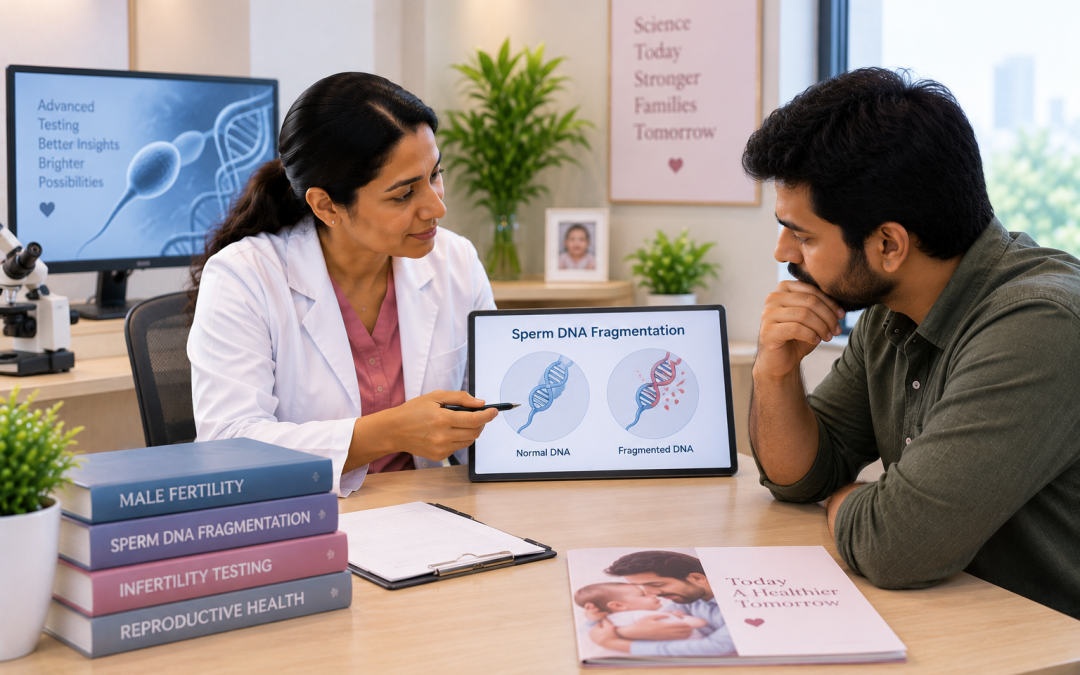
A sperm DNA fragmentation test measures damage within sperm DNA that is not captured by standard semen analysis. It is sometimes discussed after recurrent IVF failure, pregnancy loss or unexplained male-factor infertility, but it is not a universal first-line test for every couple. When people search for a sperm DNA fragmentation test, the important question is not simply whether the result is “high” or “low,” but whether testing is appropriate in their clinical situation and whether the result would change management.
How DNA fragmentation differs from semen analysis
Standard semen analysis evaluates sperm concentration, motility and morphology. DNA fragmentation testing looks at the integrity of genetic material inside sperm. A man can have apparently normal semen parameters and still have increased fragmentation, while an abnormal semen analysis does not automatically imply high DNA fragmentation. The tests answer different questions and should not be treated as interchangeable.
When testing may be discussed
Clinicians may consider testing in selected situations such as repeated assisted-reproduction failure, recurrent pregnancy loss, varicocele, significant lifestyle or environmental risk, or unexplained infertility. Recommendations vary across professional guidance, which is one reason the test should not be ordered automatically. Before testing, ask what clinical decision would change if the result were elevated.
What can influence sperm DNA damage
Oxidative stress, smoking, obesity, heat, varicocele, inflammation, advanced paternal age and some environmental exposures have been associated with increased DNA damage. However, association does not prove that correcting a single factor will always improve pregnancy outcomes. A careful history is useful because it may identify broader health issues that deserve attention regardless of the test result.
Interpreting a DFI result
Different laboratories use different assays and thresholds, so results need to be interpreted in the context of the method used. A DNA fragmentation index, or DFI, should not be read as a stand-alone prediction of pregnancy. Couples should ask about the test method, laboratory reference range, repeatability and how the result fits with semen analysis, female age, embryo development and previous treatment outcomes.
What happens if fragmentation is elevated
Management may include addressing smoking, heat, varicocele or other relevant factors, reviewing ejaculation interval, treating specific medical conditions and considering assisted-reproduction strategy. Some clinics discuss laboratory or sperm-selection approaches, but evidence varies. The most defensible plan is one that connects the proposed intervention to the couple’s specific history and explains uncertainty.
Avoid testing without a decision pathway
A diagnostic test is useful when it can change management. If the clinic cannot explain what would be done differently for a normal versus elevated result, the value of testing is less clear. This principle is especially important in fertility care, where multiple optional tests can add cost and anxiety without improving outcomes.
How this topic fits into a complete fertility evaluation
Sperm Dna Fragmentation Test should not be considered in isolation. Fertility decisions usually combine several pieces of information, including DFI, semen analysis, recurrent IVF failure, male-factor infertility. A finding that appears important on one report may become less important when the rest of the history is reviewed, while a subtle issue can become more relevant when it repeats across cycles. This is why the most useful consultation is structured around the couple’s complete reproductive timeline, not only the latest test result. If previous treatment has been attempted, bring stimulation records, semen reports, scan findings, embryology information and transfer details where available.
Questions worth asking at the consultation
Ask the clinician what the working diagnosis is, which findings are confirmed, what remains uncertain, and how sperm DNA fragmentation test changes the recommended plan. Also ask what the alternatives are, what would make the team change course, which tests are essential, and which tests are optional. If a treatment or add-on is proposed, ask what outcome it is expected to improve and what evidence supports its use in your specific situation. Clear decision points are especially helpful in fertility treatment because they prevent repeated cycles from continuing without a defined reason.
Use online information as a preparation tool, not a diagnosis
Search results can help patients learn the language of sperm DNA fragmentation test, but online information cannot account for age, medical history, ultrasound findings, semen factors, previous pregnancies or prior treatment response. Be cautious with content that promises guaranteed pregnancy, a fixed success rate, a permanent cure or one protocol for everyone. Reliable fertility education should explain uncertainty, describe alternatives and encourage questions. The purpose of reading before an appointment is to make the consultation more productive, not to replace an individual medical assessment.
A practical decision checklist before treatment
Before acting on information about sperm DNA fragmentation test, write down the exact clinical question you are trying to answer. Confirm which reports are current, which findings have been repeated, and whether both partners have been assessed where relevant. Ask how the proposed next step addresses the limiting fertility factor, what the expected benefits and burdens are, and how long the plan will be tried before review. If several options are reasonable, compare them by time, invasiveness, cost, safety and how much useful information each option is likely to provide. This makes the treatment pathway easier to understand and reduces pressure to choose an intervention simply because it is more advanced.
Related questions people often search
DNA fragmentation sperm test. For DNA fragmentation sperm test, the key question is whether the test will change diagnosis, safety, prognosis or treatment choice. More testing is not automatically better; targeted testing reduces unnecessary cost and confusion.
sperm DNA test. For sperm DNA test, the key question is whether the test will change diagnosis, safety, prognosis or treatment choice. More testing is not automatically better; targeted testing reduces unnecessary cost and confusion.
DFI test. For DFI test, the key question is whether the test will change diagnosis, safety, prognosis or treatment choice. More testing is not automatically better; targeted testing reduces unnecessary cost and confusion.
sperm fragmentation infertility. The phrase sperm fragmentation infertility is useful as a search starting point, but the clinical meaning depends on the wider fertility history. A specialist should connect the term to the patient’s diagnosis, test results, age and treatment goals.
Specialist fertility evaluation at MotherToBe
For an individual assessment, patients can review the profile of Dr. S. Vyjayanthi, Director & Consultant Fertility Specialist at MotherToBe Fertility Clinic & Academy, Madhapur, Hyderabad. Treatment decisions should be based on the complete clinical context, including diagnosis, reproductive age, previous treatment, partner factors and personal goals. male infertility evaluation provides the relevant service-page overview for this topic.
Key takeaways
The central point is that sperm DNA fragmentation test is a clinical context rather than a single number or label. The most appropriate next step depends on the diagnosis, reproductive age, partner factors, previous treatment and personal goals. A good fertility plan should be understandable: you should know why each test or treatment is being recommended, what could change the plan and when progress will be reviewed. This approach supports informed decision-making while avoiding both unnecessary delay and unnecessary intervention.
Frequently Asked Questions
Is sperm DNA fragmentation the same as semen analysis?
No. Semen analysis measures concentration, movement and morphology, while DNA fragmentation testing assesses damage to sperm genetic material.
Can a normal semen analysis have high DNA fragmentation?
Yes, it is possible. The tests evaluate different characteristics.
Does a high DFI mean IVF will fail?
No. It may be associated with reproductive outcomes in some settings, but it does not provide a certain prediction for an individual cycle.
Should every man with infertility have a DNA fragmentation test?
No. It is usually considered selectively when the result is likely to answer a specific clinical question.
Next step
If this topic is relevant to your fertility journey, review male infertility evaluation and prepare your previous reports, treatment records and questions for a personalised consultation. Medical decisions should be made after individual evaluation rather than from online information alone.