
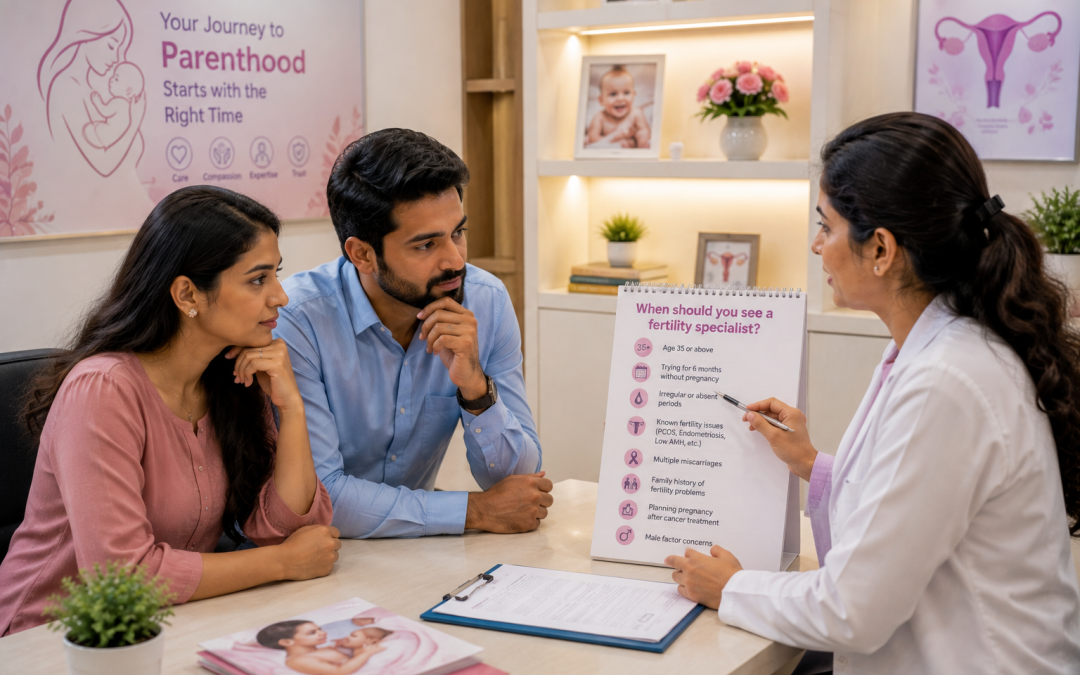
A common question when searching for a fertility specialist in Hyderabad is whether it is too early—or too late—to seek help. Infertility is generally defined around failure to achieve pregnancy after a period of regular unprotected intercourse, but the right time for evaluation depends on age, medical history and known reproductive concerns. Some people should seek advice earlier than the standard waiting period.
When routine evaluation is commonly considered
For many younger people without known fertility problems, evaluation is considered after a period of regular unprotected intercourse without pregnancy. The interval changes with age and clinical context. Rather than relying on a single internet rule, use a consultation to determine what is appropriate for your situation.
Reasons to seek help earlier
Earlier assessment can be appropriate with irregular or absent periods, known PCOS or endometriosis, previous pelvic surgery, recurrent pregnancy loss, prior cancer treatment, suspected male-factor infertility, or a history suggesting reduced ovarian reserve. Age-related concerns may also justify earlier advice.
What a fertility specialist evaluates
A fertility specialist considers ovulation, ovarian reserve, the uterus and tubes where relevant, semen factors, previous pregnancies and treatment history. The purpose is to build a working diagnosis and avoid assuming that infertility is only a female issue.
What to expect from the first plan
The first plan may be additional testing, lifestyle or medication changes, ovulation treatment, IUI, IVF or referral for another procedure. A good specialist explains why the next step is suitable and how progress will be reviewed.
How to evaluate a specialist
Review qualifications, reproductive-medicine training, experience in your type of problem, and how clearly the doctor explains uncertainty and options. For an overview of the clinical team, you can review the profile of fertility specialist Dr. S. Vyjayanthi on MotherToBe’s website.
Do not choose by superlatives alone
Terms such as ‘best’ or ‘top’ are difficult to verify objectively. Patients are better served by comparing credentials, approach, laboratory support, transparency, follow-up and whether treatment is individualised.
What makes a fertility specialist different
A fertility specialist focuses on reproductive diagnosis and treatment across ovulation, ovarian reserve, tubal factors, male factors, assisted reproduction and fertility preservation. The value is not simply access to IVF; it is the ability to decide when IVF is unnecessary, when it is appropriate and how it should be individualised.
Prepare a one-page fertility timeline
Write down when you started trying, previous pregnancies and losses, surgeries, fertility treatments, key test dates and medication responses. A one-page timeline can make a complex history easier for the specialist to review and can improve the usefulness of a second-opinion visit.
About Dr. S. Vyjayanthi
At MotherToBe Fertility Clinic & Academy, Madhapur, Hyderabad, fertility care is led by Dr. S. Vyjayanthi, MD, DGO, DNB, MRCOG, MSc (Embryology, UK), CCT (UK), a Subspecialist in Reproductive Medicine & Surgery (RCOG, UK). She serves as Director & Consultant Fertility Specialist at MotherToBe.
Her professional leadership roles include President, Telangana Chapter RCOG; Managing Committee Member, The PCOS Society of India; and Managing Committee Member, Fertility Preservation Society of India.
Her work spans reproductive medicine, surgery, embryology and fertility care. For patients seeking a fertility specialist in Hyderabad, the qualifications and professional roles above provide verifiable context beyond promotional labels such as ‘best’ or ‘top’.
Read more about Dr. S. Vyjayanthi’s qualifications, leadership roles and Director’s Message on the MotherToBe website.
Frequently Asked Questions
Can a fertility specialist treat PCOS?
Yes, particularly when PCOS is affecting ovulation or fertility. Some aspects of PCOS care may also involve general gynaecology, endocrinology or metabolic care.
Should men attend a fertility consultation?
Often yes, because male factors can contribute to infertility and semen evaluation may be part of the assessment.
Does seeing a fertility specialist mean I need IVF?
No. IVF is only one possible treatment.
Can I seek a second opinion after failed IVF?
Yes. Bring stimulation records, embryology reports, transfer notes and test results so the new specialist can review the full cycle.
Key takeaways
- Choose treatment or a specialist based on diagnosis, evidence, transparency and individual needs—not on unverified ‘best’ or ‘top’ claims.
- Use the target keyword naturally in the title, introduction and relevant context. Do not repeat it mechanically throughout the article.
- Link this article to the relevant MotherToBe service page and link back from related educational content where it genuinely helps the reader.
- Have the medical content reviewed before publication and update it when important clinical guidance changes.
Suggested internal links
Primary service link: fertility specialist Dr. S. Vyjayanthi
Doctor profile link: Dr. S. Vyjayanthi – Director’s Message
Also add 2–4 natural internal links to closely related MotherToBe guides where relevant. Vary anchor text and avoid sitewide exact-match repetition.
Medical review and publishing note
Educational content only. Before publication, a qualified fertility specialist should verify the medical statements, local legal/regulatory details, clinic-specific services, doctor credentials and any costs or outcome data. Add the reviewer name, credentials and review date only after a real review. Proposed medical reviewer: Dr. S. Vyjayanthi; publish only after her review and approval of the clinical wording.
References for medical review
- WHO: Infertility fact sheet (2025)
- ASRM: Definition of Infertility committee opinion (2023)